
What is Tarraxo? The complete guide to the dance and its music
Tarraxo is a close-connection partner dance, danced to heavy, slow, bass-driven music. It grew out of Angolan Tarraxinha, found its sound in Lisbon and took its shape on the dance floors of Europe. This guide explains where it comes from, how it differs from Kizomba and Urbankiz, what the music sounds like and how to start.
By Dawou Tarraxo, pioneer of Tarraxo, teacher in 50+ countries and author of the TOCA Method.
In this guide
- Tarraxo in one sentence
- Where does Tarraxo come from?
- What does the word Tarraxo mean?
- Tarraxo, Tarraxinha, Kizomba, Urbankiz: what is the difference?
- Tarraxo music: what does it sound like?
- How does Tarraxo feel? The technique
- The TOCA Method: a way to learn and teach Tarraxo
- How to start learning Tarraxo
- Common beginner mistakes
- Respect, consent and comfort
- Where to dance Tarraxo
- About the author: Dawou Tarraxo
- Frequently asked questions
Tarraxo in 30 seconds
- A partner dance in close embrace, almost on the spot, built on weight, grounded posture and small controlled movements.
- Its roots: Tarraxinha from the Benguela province of Angola, then Tarraxo music in Lisbon in the early 2010s.
- It is related to Kizomba and Urbankiz, but it is not the same dance: no walking basic, more stillness, more pause.
- The pronunciation is “ta-RA-sho”: in Portuguese, the x sounds like sh.
Tarraxo in one sentence
Tarraxo is a close-connection partner dance built on heavy bass, grounded posture and small controlled isolations. The couple stays almost in place: the dance happens inside the embrace, in the weight transfers, the hips, the pauses and the breathing, more than in travelling steps.
What makes it special is the relationship with the music. Where many partner dances step on the beat, Tarraxo holds the weight and plays between the beats. A good Tarraxo dancer can stay still for a full phrase and still be dancing.
Where does Tarraxo come from?
The story starts in Angola with Tarraxinha. Tarraxinha music began as a slowed-down version of Kuduro, reportedly in the Benguela province, with DJs such as DJ Madabaya in the early 2000s. In Angola, the word names both the music and the dance: a slow, very close couple dance with no walking.
In the early 2010s, producers in Lisbon pushed that sound further. Tarraxo music appeared as a darker, rawer, more percussive version of Tarraxinha, less melodic and more focused on rhythm. DJ BeBeDeRa is often named among its pioneers.
The dance then took its current shape on the European scene in the 2010s, as teachers built a structured way to dance and teach it. Kizzy and Gwany played a central role in that work and in spreading the style through workshops, dancer teams and festivals. Gwany, Kizzy and Liliana de Lima founded Global Tarraxo, the festival circuit that now runs editions in Paris, Montreal, Dubai and Barcelona.
Tarraxinha, a slowed down Kuduro, fills the dance floors of the Benguela province.
Producers push a darker, heavier, more percussive sound: Tarraxo music.
Teachers give the dance a structure and spread it through workshops and festivals.
Festivals, socials and a new generation of producers and teachers.
What does the word Tarraxo mean?
In Portuguese, tarraxa means a screw, and tarraxinha a small screw. The image says a lot about the dance: two bodies turning slowly around one shared axis, tight, controlled, with very little space between them. Tarraxo is the name the European scene gave to the style danced to this newer, heavier music.
It is pronounced “ta-RA-sho”. The double r is rolled lightly and the x sounds like the English sh.
Tarraxo, Tarraxinha, Kizomba, Urbankiz: what is the difference?
These four names are often mixed up because they share the same festivals and often the same dancers. They are not the same dance.
| Tarraxo | Tarraxinha | Kizomba | Urbankiz | |
|---|---|---|---|---|
| Origin | Europe (Lisbon music, 2010s) | Angola (Benguela) | Angola | France |
| Music | Slow, dark, heavy bass | Slowed-down Kuduro | Melodic, Semba roots | Ghetto zouk, R&B, electro |
| Travel | Almost none | None | Walking, circular | Linear, sharp stops |
| Feeling | Weight, pause, control | Very close, sensual | Smooth, warm | Precise, modern |
Tarraxo music: what does it sound like?
Tarraxo music is slow and heavy. The bass and the percussion carry the song, the melody stays in the background, and the space between the hits matters as much as the hits themselves. That space is what the dancers play with: a pause, a suspended weight, a slow release.
Today, many producers mix Tarraxo with Afrobeats, Afro-pop and R&B textures. Dawou Tarraxo produces in that spirit: 29 releases since 2024, a new single almost every month, often with YnG Cole and Ky Sheny, and the album Between Two Worlds. You can play a preview of every track on the music page.
How does Tarraxo feel? The technique
Tarraxo is felt before it is seen. The basics are simple to describe and take years to master:
- A grounded posture: knees soft, weight low, the body organised around a stable centre.
- The lead comes from the leg, not from the chest or the arms. The follower feels the intention through the weight before any movement shows.
- Micro-movement: small isolations of the hips, the ribs and the shoulders, never big for the sake of being big.
- The pause is part of the dance. Holding still on the music is a choice, not a lack of ideas.
- Breathing together. Slow music asks for slow breath, and the couple finds a shared rhythm.
- The frame holds and the legs speak: the embrace stays stable while the lower body tells the story.
The TOCA Method: a way to learn and teach Tarraxo
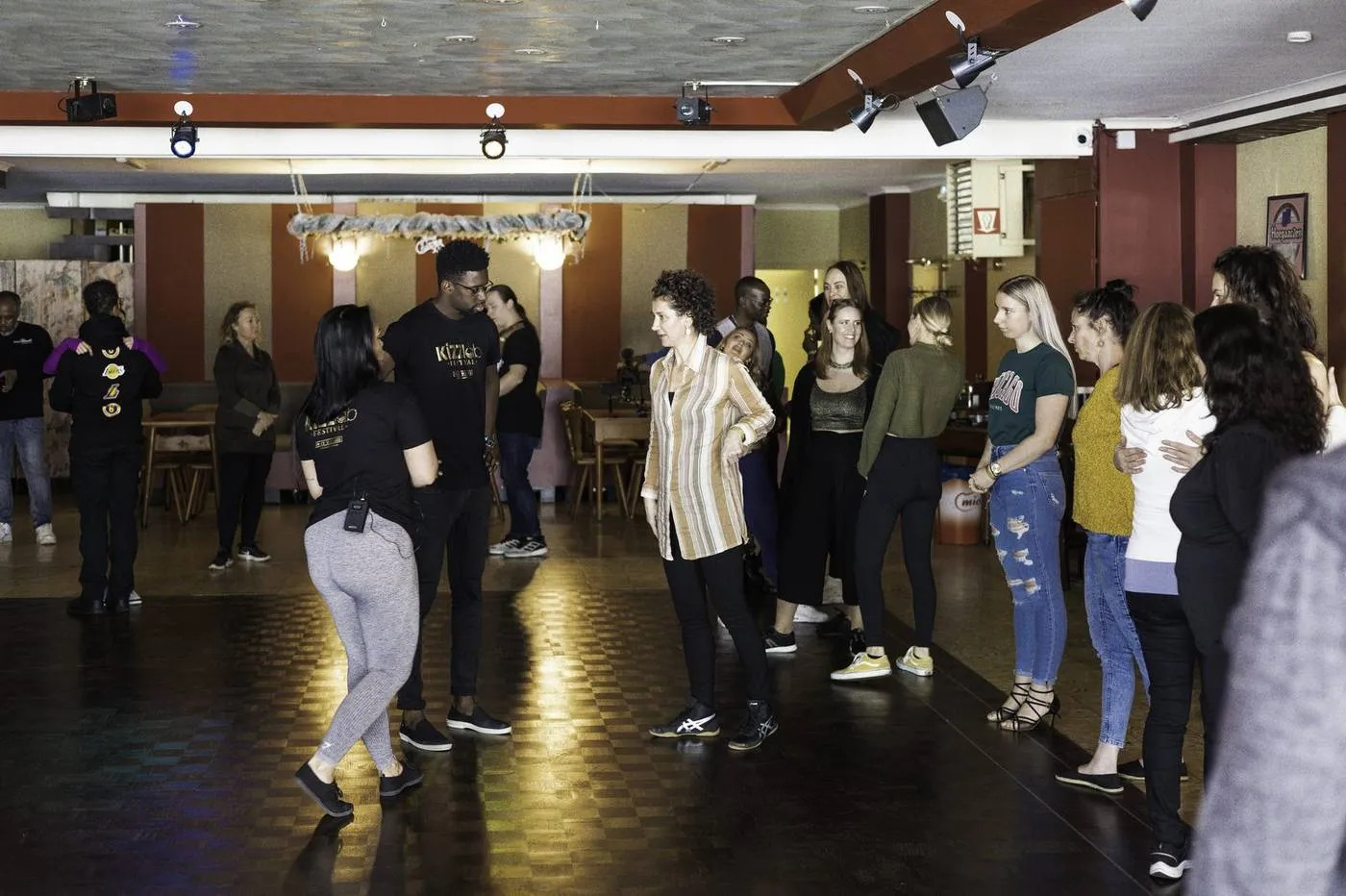
Dawou Tarraxo created the TOCA Method to teach Tarraxo, Kizomba and Urbankiz in a clear and progressive way. TOCA stands for Touch, Observation, Control and Awareness: the four things he checks in every dancer before looking at steps.
The method exists as two books, the student’s book and the teacher’s guide, in English, French and Spanish, and it will be the backbone of the Online Academy that opens before the end of 2026.
How to start learning Tarraxo
You do not need a partner or a background in Kizomba to start. These steps help most beginners:
- Listen first. Spend time with Tarraxo music and notice the bass, the breaks and the silences.
- Take a beginner masterclass or a private lesson to get the posture and the embrace right from day one.
- Work on the walk-free basics: weight transfer on the spot, small pulses, holding a pause.
- Dance with many partners at socials. Tarraxo is a conversation, and every partner teaches you something.
- Film yourself. Slow Tarraxo shows everything, which is exactly why it is such a good teacher.
Common beginner mistakes
Most of them come from trying to do too much:
- Leading with the arms or the chest instead of the weight.
- Over-dancing when the music is already full.
- Rushing the pauses instead of holding them.
- Dropping the posture and losing the shared axis.
- Forgetting that your partner feels everything, including tension and hesitation.
Respect, consent and comfort
Tarraxo is danced very close, so respect comes first. Ask before you dance, adapt the closeness to your partner, read their comfort throughout the song and say thank you at the end. Connection without comfort is not connection.
Where to dance Tarraxo
Tarraxo lives in Kizomba and Urbankiz festivals, at dedicated Tarraxo events such as the Global Tarraxo circuit, and in weekly socials in many cities across Europe, the Middle East, Asia and the Americas.
Dawou Tarraxo teaches masterclasses, private lessons and festival workshops in Dubai and around the world. The Live section lists his next dates.
About the author: Dawou Tarraxo
Dawou Tarraxo started dancing in 2014, trained in Tarraxo with Gwany and Kizzy and became an official Tarraxo dancer in 2020, creating the first Tarraxo dancer team. He taught at Tarraxo School in Paris, London and Dubai, has taught in more than 50 countries and produces Tarraxo music. He is a pioneer of the style, not its founder: that credit belongs to the people who shaped it before him.
Frequently asked questions
Is Tarraxo the same as Kizomba?
No. They share festivals and dancers, but Tarraxo has no walking basic, stays almost on the spot and plays with weight and pauses on slower, heavier music.
Is Tarraxo the same as Tarraxinha?
Tarraxo grew out of Tarraxinha. Tarraxinha is the Angolan original; Tarraxo is the European style danced to the darker Tarraxo music that appeared in Lisbon in the early 2010s.
How do you pronounce Tarraxo?
“Ta-RA-sho”. In Portuguese, the x sounds like the English sh.
Do I need a partner to learn Tarraxo?
No. Masterclasses and socials rotate partners, and private lessons can be taken alone.
Who created Tarraxo?
Tarraxo is the work of a whole scene: Angolan Tarraxinha, Lisbon producers, and European teachers such as Kizzy and Gwany who shaped the dance. Dawou Tarraxo is one of the pioneers who spread it worldwide.
Where can I learn Tarraxo with Dawou Tarraxo?
In masterclasses and festival workshops, in private lessons in Dubai or online, and soon in the Online Academy, opening before the end of 2026.